Copper and Copper Alloys: A Practical Selection Guide for Industrial Applications
A practical guide to selecting copper, brass, bronze, copper-nickel and silver-bearing copper alloys for electrical, plumbing, refrigeration, marine, heat-exchanger and industrial applications.
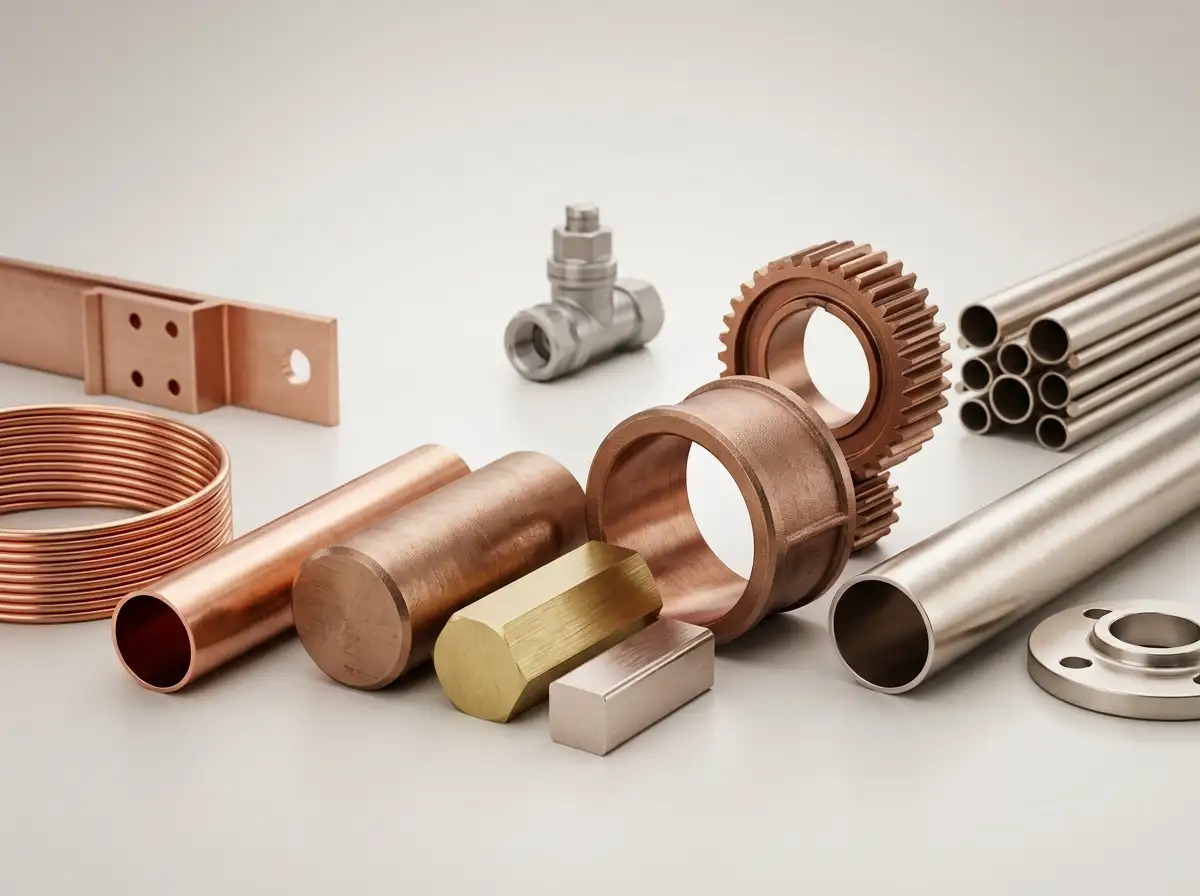
This article provides general technical reference. Alloy, product form and specification selection should be verified against the applicable product standard, service environment and project requirements.
Copper and copper alloys are widely used in industrial equipment because they combine electrical and thermal conductivity with corrosion resistance, formability, wear resistance and, depending on the alloy family, high mechanical strength.
Selecting the appropriate copper alloy requires more than choosing a material family. The required electrical conductivity, mechanical properties, corrosion resistance, manufacturing process, operating environment, product form and applicable standard should all be considered.
This guide compares the main copper alloy families and provides a practical framework for selecting grades for electrical, plumbing, refrigeration, marine and industrial applications.
Quick Copper Alloy Selection Guide
The appropriate copper alloy depends primarily on the required performance and service environment.
| Requirement | Typical Material Choice |
|---|---|
| High electrical conductivity | C11000 / Cu-ETP |
| Copper tube for plumbing | C12000 or C12200, depending on specification |
| Refrigeration tubing | C12200 / Cu-DHP |
| High conductivity with improved thermal stability | Silver-bearing copper alloys |
| High formability | C26000 brass |
| General brass fittings and components | Selected brass grades according to application |
| Wear-resistant bearings and bushings | Tin bronze |
| High-strength marine components | Aluminium bronze |
| Seawater piping | 90/10 or 70/30 copper-nickel |
| Marine valves and pump components | Aluminium bronze or copper-nickel, depending on design |
| Heat exchangers | Copper, copper-nickel or selected brass alloys depending on water chemistry |
This table provides a general starting point. Final material selection should be based on the applicable product standard, operating conditions and required mechanical and corrosion performance.
Copper Alloy Families
Pure and High-Purity Copper
Commercially pure copper is normally selected when electrical or thermal conductivity is a primary requirement.
C11000, commonly associated with Cu-ETP, is widely used for electrical conductors, busbars, electrical components and other applications where high conductivity is important. 1
C12200, commonly associated with Cu-DHP, is widely used in tube applications because its deoxidized composition provides good fabrication characteristics and suitability for brazing and forming.
The distinction between these grades is important. C11000 and C12200 should not simply be treated as interchangeable grades of “pure copper” because their properties and typical applications differ.
Typical applications include:
- Electrical conductors
- Busbars
- Transformer and electrical components
- Heat-exchanger tubing
- Plumbing tube
- Refrigeration tube
- General industrial tubing
For electrical applications, conductivity is normally the primary consideration. For tube applications, fabrication requirements, brazing behavior and applicable standards also become important.
Brasses
Brasses are primarily copper-zinc alloys. Increasing or modifying the alloying content can change strength, ductility, machinability, corrosion resistance and formability.
C26000, commonly known as cartridge brass, contains approximately 30% zinc and provides a useful combination of strength and cold formability. It is commonly used for formed components, fittings and other applications where ductility is important.
Other brass compositions may be selected when machining, strength or corrosion resistance is more important than cold-forming capability.
Typical applications include:
- Plumbing fittings
- Valve components
- Fasteners
- Machined components
- Formed parts
- Architectural hardware
- Industrial fittings
One important consideration with some high-zinc brasses is dezincification. In susceptible environments, particularly certain water chemistries, dezincification-resistant brass should be specified according to the applicable standard and service requirements.
Material selection should therefore consider not only the nominal alloy family but also water chemistry, temperature, service conditions and regulatory requirements.
Bronzes
The term bronze covers several copper-alloy families rather than a single alloy system.
Traditional tin bronzes contain copper and tin and are widely used where wear resistance, strength and corrosion resistance are required. Other important bronze families include aluminium bronzes and silicon bronzes.
Tin Bronze
Tin bronzes such as C90300 and C90500 are commonly used for bearings, bushings, gears and other components where wear resistance and mechanical performance are important.
Typical applications include:
- Bearings
- Bushings
- Gears
- Wear plates
- Industrial machinery components
- Marine components
Aluminium Bronze
Aluminium bronzes contain aluminium as a principal alloying element and can provide high strength together with good corrosion resistance.
C95400 is a commonly used aluminium bronze grade for industrial and marine components.
Typical applications include:
- Marine valves
- Pump components
- Valve trim
- Bearings
- Shipbuilding components
- Industrial equipment
Aluminium bronze is particularly useful where both mechanical strength and resistance to marine environments are important.
Copper-Nickel Alloys
Copper-nickel alloys are widely used in marine and seawater applications because of their corrosion resistance and resistance to biofouling.
The two most common industrial compositions are approximately:
- 90/10 copper-nickel, commonly represented by C70600
- 70/30 copper-nickel, commonly represented by C71500
These alloys are widely used for:
- Seawater piping
- Marine cooling systems
- Condensers
- Heat exchangers
- Offshore equipment
- Shipboard piping
- Desalination and seawater systems
Copper-nickel alloys can provide good long-term performance in seawater service, but final selection should consider seawater chemistry, flow velocity, temperature, oxygen conditions, system design and applicable standards.
They should therefore be viewed as a widely established solution for marine service rather than as a universally “best” material for every seawater application.
Silver-Bearing Copper Alloys
Silver-bearing copper alloys are specialty copper materials in which controlled additions of silver are used to improve thermal stability and mechanical performance while retaining high electrical and thermal conductivity.
Compared with commercially pure copper, silver-bearing copper alloys can provide improved resistance to thermal softening and better mechanical stability during elevated-temperature operation.
They are generally considered when an application requires a combination of:
- High electrical conductivity
- Resistance to thermal softening
- Improved mechanical stability at elevated temperatures
- Long-term dimensional stability
- Reliable performance under thermal cycling
Silver-bearing copper is a family rather than a single grade. The appropriate silver content and material designation depend on the required properties, product form and applicable standard.
CuAg0.1 Silver-Bearing Copper
CuAg0.1 is one representative grade within the silver-bearing copper family. It contains approximately 0.1% silver and is used where high conductivity needs to be combined with improved thermal-mechanical stability.
Common designations associated with this material include:
| Standard System | Designation |
|---|---|
| EN | CuAg0.1 |
| DIN | CuAg0.1 OF |
| ASTM / UNS | C10700 2 |
CuAg0.1 may be considered for demanding electrical and industrial applications such as:
- Electric motor components
- Generator components
- High-current conductors
- Electrical contacts
- Railway and traction systems
- Specialized copper tubes and conductors
- Other electrical components exposed to elevated temperatures
The principal advantage of silver-bearing copper is the balance between conductivity and thermal stability. It should not be regarded as a universal replacement for commercially pure copper. Where maximum conductivity at normal operating temperatures is the primary requirement, conventional high-conductivity copper may remain the more appropriate choice.
For applications involving continuous heating, thermal cycling or elevated operating temperatures, silver-bearing copper alloys can provide an alternative when improved resistance to thermal softening is required.
Copper vs Brass vs Bronze vs Copper-Nickel vs Silver-Bearing Copper
The major copper alloy families differ significantly in their typical properties and applications.
| Material Family | Main Alloying Element | Primary Advantage | Typical Applications |
|---|---|---|---|
| Pure copper | None or very low alloying additions | Electrical and thermal conductivity | Conductors, busbars, tubes |
| Brass | Zinc | Formability and machinability | Fittings, valves, fasteners |
| Tin bronze | Tin | Wear resistance and strength | Bearings, bushings, gears |
| Aluminium bronze | Aluminium | Strength and corrosion resistance | Marine valves, pumps, industrial components |
| Copper-nickel | Nickel | Seawater corrosion resistance | Marine piping, condensers, heat exchangers |
| Silver-bearing copper | Silver | High conductivity with improved thermal stability | Motors, generators, electrical components |
The comparison shows why there is no single “best” copper alloy. The appropriate material depends on which performance characteristics are most important for the application.
How to Select a Copper Alloy
Copper alloy selection should begin with the operating requirements rather than the alloy name.
1. Electrical Conductivity
When electrical conductivity is the primary requirement, commercially pure copper is normally the first material family to consider.
C11000 / Cu-ETP is widely used where high electrical conductivity is required.
For applications involving elevated temperatures or continuous thermal cycling, silver-bearing copper alloys such as CuAg0.1 may also be considered when improved resistance to thermal softening is required.
For electrical components, the selection should also consider:
- Required conductivity
- Temperature
- Mechanical strength
- Joining method
- Product form
- Applicable electrical standard
2. Mechanical Strength
If strength is more important than maximum conductivity, alloying copper with elements such as zinc, tin, aluminium, nickel or silver can provide significantly different mechanical properties.
Brasses are commonly selected for their combination of strength, formability and machinability.
Bronzes and aluminium bronzes are often considered when higher strength and wear resistance are required.
Silver-bearing copper alloys can be considered where high conductivity must be retained while improved mechanical stability at elevated temperatures is required.
3. Corrosion Resistance
Corrosion resistance depends strongly on the service environment.
For example:
- Freshwater service may favor specific copper or brass grades.
- Seawater service commonly uses copper-nickel or aluminium bronze.
- Industrial chemical environments may require a more detailed compatibility assessment.
- High-zinc brasses may require special consideration where dezincification is possible.
The alloy should therefore be selected based on the actual medium, temperature, flow conditions and expected service life.
4. Wear Resistance
For bearings, bushings and sliding components, wear resistance can be more important than electrical conductivity.
Tin bronzes are commonly used in these applications because they provide a useful combination of strength, wear resistance and corrosion resistance.
Aluminium bronzes may also be selected for heavily loaded components where higher strength is required.
5. Manufacturing Process
The required manufacturing process can influence alloy selection.
Important considerations include:
- Cold forming
- Hot forming
- Machining
- Extrusion
- Drawing
- Rolling
- Forging
- Welding
- Brazing
- Heat treatment
For example, a highly formable brass may be preferred for deep-drawn components, while a different alloy may be selected when machining efficiency is the primary consideration.
For specialized copper products such as precision tubes and electrical conductors, the required alloy, temper, dimensional tolerance and manufacturing process should be evaluated together.
Copper Alloy Selection by Application
Electrical Applications
Electrical applications generally prioritize high conductivity.
Typical choices include:
- C11000 / Cu-ETP
- Other high-conductivity copper grades where required
- Silver-bearing copper alloys such as CuAg0.1 where improved thermal stability is required
Typical products include:
- Busbars
- Conductors
- Electrical connectors
- Transformer components
- Electrical terminals
- Motor components
- Generator components
Silver-bearing copper alloys are particularly relevant where electrical components experience continuous heating, high current loading or repeated thermal cycling.
The final grade should be selected according to the required conductivity, mechanical condition, operating temperature, dimensions and applicable electrical specification.
Plumbing and Water Tube
Copper tube is widely used in plumbing and water distribution systems.
C12000 and C12200 are among the copper grades covered by ASTM B88 3 for seamless copper water tube.
Selection should consider:
- Water chemistry
- Pressure
- Temperature
- Tube type
- Joining method
- Applicable local requirements
ASTM B88 defines requirements for seamless copper water tube and its applicable grades and dimensions.
Refrigeration
Copper is widely used for refrigeration and air-conditioning tubing because of its thermal conductivity, formability and compatibility with common joining processes.
C12200 / Cu-DHP is commonly used for refrigeration tube.
ASTM B280 4 covers seamless copper tube for air-conditioning and refrigeration field service and includes grades such as C10200, C12000 and C12200.
For refrigeration applications, tube cleanliness, dimensional accuracy, pressure requirements and joining method are also important considerations.
Marine Applications
Marine applications require careful consideration of seawater corrosion, flow conditions, biofouling, mechanical loading and temperature.
Common copper alloy choices include:
- 90/10 copper-nickel
- 70/30 copper-nickel
- Aluminium bronze
- Selected brass and bronze grades for specific components
Copper-nickel is commonly used for seawater piping and heat-exchanger systems, while aluminium bronze is frequently used for valves, pumps and other components requiring higher mechanical strength.
Heat Exchangers
Heat-exchanger material selection depends strongly on the heat-transfer medium and water chemistry.
Potential materials include:
- Pure copper
- Copper-nickel
- Aluminium brass
- Other copper alloys designed for specific service conditions
The correct selection depends on:
- Fluid composition
- Seawater exposure
- Temperature
- Flow velocity
- Corrosion risk
- Fouling and biofouling
- Required service life
For this reason, heat-exchanger material selection should be based on the complete operating environment rather than thermal conductivity alone.
Common Copper Alloy Grades
The following grades are commonly encountered in industrial applications.
| Alloy Family | UNS Grade | Common Designation | Typical Application |
|---|---|---|---|
| Pure copper | C11000 | Cu-ETP | Electrical components, conductors |
| Deoxidized copper | C12200 | Cu-DHP | Plumbing and refrigeration tube |
| Silver-bearing copper | C10700 | CuAg0.1 | High-performance electrical components |
| Brass | C26000 | Cartridge brass | Formed components, fittings |
| Tin bronze | C90300 | Tin bronze | Bearings, gears, bushings |
| Tin bronze | C90500 | Tin bronze | Bearings and industrial components |
| Aluminium bronze | C95400 | Aluminium bronze | Marine valves, pumps |
| Copper-nickel | C70600 | 90/10 Cu-Ni | Marine piping, heat exchangers |
| Copper-nickel | C71500 | 70/30 Cu-Ni | Marine and seawater systems |
The grades shown above are representative examples rather than a complete list of copper and copper-alloy grades.
Silver-bearing copper includes multiple compositions and designations. CuAg0.1 / C10700 is one example and should be specified together with the applicable product standard, product form and required condition.
Grade selection should always be verified against the applicable product standard because alloy designation alone does not define all requirements for a finished product.
Standards and Documentation
For industrial procurement, the applicable product standard is an important part of the material specification.
Common standards used for copper and copper-alloy products include ASTM, EN and JIS specifications.
Examples include:
- ASTM B88 for seamless copper water tube
- ASTM B280 for seamless copper tube used in air-conditioning and refrigeration field service
- ASTM B466/B466M 5 for seamless copper-nickel pipe and tube
Depending on the product and application, procurement specifications may also define:
- Chemical composition
- Mechanical properties
- Electrical conductivity
- Dimensions and tolerances
- Temper or delivery condition
- Surface condition
- Testing requirements
- Inspection requirements
- Certificate requirements
- Heat or batch traceability
- Country or origin requirements
For critical applications such as marine, oil and gas, power generation and chemical processing, documentation and traceability can be as important as the nominal alloy grade.
How to Specify a Copper Alloy for Procurement
A complete copper alloy inquiry should normally include more than the material name.
Useful information includes:
- Alloy designation or UNS number
- Applicable ASTM, EN or JIS standard
- Product form
- Outside diameter, inside diameter or other dimensions
- Wall thickness
- Length
- Temper or delivery condition
- Required quantity
- Mechanical or electrical requirements
- Surface and dimensional requirements
- Inspection and certification requirements
- Intended application and service environment
For example, instead of requesting simply “copper tube”, an industrial RFQ may specify:
C12200 copper tube, ASTM B280, specified OD and wall thickness, straight length, required temper, quantity and inspection documentation.
For a specialized silver-bearing copper product, a more complete inquiry may specify the alloy designation, applicable standard, product form, dimensions, temper or hardness, electrical or mechanical requirements, quantity and inspection documentation.
Frequently Asked Questions
What is the best copper alloy for electrical applications?
C11000 / Cu-ETP is commonly selected when high electrical conductivity is the primary requirement. The final choice should also consider mechanical requirements, temperature, product form and applicable standards.
What are silver-bearing copper alloys?
Silver-bearing copper alloys are copper-based alloys containing controlled additions of silver. They are designed to retain high electrical conductivity while providing improved thermal stability and resistance to softening compared with conventional pure copper in suitable applications.
What is CuAg0.1 copper?
CuAg0.1 is a silver-bearing copper alloy containing approximately 0.1% silver. It is one representative grade within the broader silver-bearing copper alloy family.
It can be selected for electrical and industrial applications where high conductivity needs to be combined with improved thermal-mechanical stability.
What is C10700 copper used for?
C10700 is a UNS designation associated with silver-bearing copper such as CuAg0.1.
Typical applications include high-performance electrical components, conductors, motor and generator components and specialized copper products where improved resistance to thermal softening is required.
What is the difference between copper and brass?
Copper is primarily an elemental metal, while brass is a copper-zinc alloy. Brass generally provides higher strength and better machinability or formability than pure copper, depending on the specific grade.
What is the difference between brass and bronze?
Brass is primarily a copper-zinc alloy, while bronze refers to several copper-alloy families, traditionally including copper-tin alloys. Aluminium bronze and silicon bronze are also important industrial bronze families.
Which copper alloy is best for seawater?
90/10 and 70/30 copper-nickel alloys are widely used for seawater piping, condensers and marine heat-exchanger systems. Aluminium bronze is also commonly used for marine valves, pumps and other components where higher mechanical strength is required.
What copper is commonly used for refrigeration tubing?
C12200 / Cu-DHP is commonly used for refrigeration tubing. ASTM B280 covers seamless copper tube for air-conditioning and refrigeration field service and includes C12200 among its specified copper grades.
What copper is commonly used for plumbing?
C12000 and C12200 are commonly used for copper water tube covered by ASTM B88. The appropriate grade and tube type should be selected according to the water chemistry, pressure, temperature and applicable local requirements.
How do I choose a copper alloy?
Start with the application’s primary requirements: electrical conductivity, mechanical strength, corrosion resistance, wear resistance and manufacturing process.
Then select the appropriate alloy grade, product form, temper and applicable ASTM, EN or JIS standard.
Does copper alloy selection depend on the product form?
Yes. The same alloy family may be available as tube, pipe, plate, sheet, bar, wire, forging or other forms, but the applicable product standard and required properties can differ.
Product form should therefore be specified together with the alloy designation.
Conclusion
Copper and copper alloys provide a broad range of material solutions for electrical, plumbing, refrigeration, marine and industrial applications.
The main selection principle is to match the alloy to the required performance:
- Pure copper for high electrical and thermal conductivity
- Brass for combinations of formability, strength and machinability
- Tin bronze for wear-resistant components
- Aluminium bronze for high-strength and corrosion-resistant industrial and marine components
- Copper-nickel for demanding seawater and marine applications
- Silver-bearing copper alloys for high-conductivity applications requiring improved thermal stability
For industrial procurement, the alloy grade should be considered together with the product form, dimensions, temper, applicable standard, service environment and documentation requirements.
A properly defined material specification reduces ambiguity during sourcing and provides a more reliable basis for technical evaluation, quotation and production.
References
-
The Copper Development Association, Copper and Copper Alloys — alloy database and technical data. copper.org ↩
-
International Organization for Standardization, ISO 6208 — Non-ferrous metal and alloy reference designations (UNS system). ISO 6208 ↩
-
ASTM International, ASTM B88/B88M — Standard Specification for Copper Water Tube, Medium Pressure. ASTM B88 ↩
-
ASTM International, ASTM B280/B280M — Standard Specification for Seamless Copper Tube, General Refrigeration and Air-Conditioning Field Service. ASTM B280 ↩
-
ASTM International, ASTM B466/B466M — Standard Specification for Seamless Copper-Nickel Alloy (Cupronickel) Pipe and Tube, General Requirements for. ASTM B466 ↩
Zitieren als Wayland Steel Editorial Team (2026). Copper and Copper Alloys: A Practical Selection Guide for Industrial Applications. Wayland Steel Insights. https://www.waylandsteel.com.cn/de-de/insights/copper-alloys-industrial-selection/
Benötigen Sie eine industrielle Metalllösung?
Wayland Steel liefert Stahlprodukte, Kupferlegierungen und Aluminiumlösungen für globale industrielle Anwendungen.