Aluminium Alloy Selection Guide: 1xxx, 3xxx, 5xxx, 6xxx and 7xxx
A practical guide to aluminium alloy selection for aerospace, construction, marine and industrial applications, comparing strength, formability, weldability and corrosion resistance.
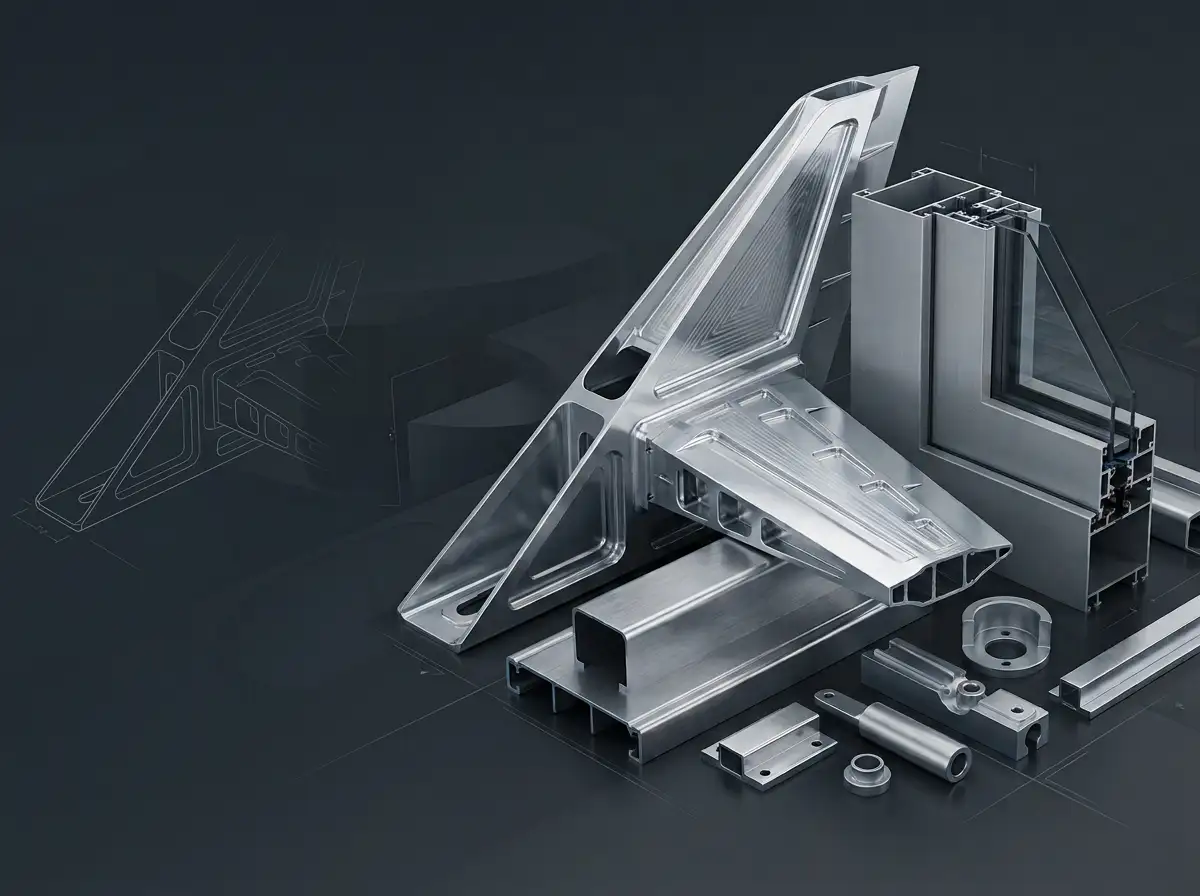
This article provides general technical reference. Alloy, temper and product standard selection should be verified against the applicable product standard, design requirements and service environment.
Aluminium is not a single material. Its different alloy families offer significantly different combinations of strength, formability, weldability, corrosion resistance and machinability.
For engineers, fabricators and industrial buyers, selecting the right aluminium alloy is therefore a material-selection decision, not simply a choice between aluminium products.
This guide compares the main aluminium alloy families — 1xxx, 3xxx, 5xxx, 6xxx and 7xxx series — and explains where commonly specified grades such as 1050, 3003, 5052, 5083, 6061, 6082, 7075 and 2024 are typically used.
Aluminium Alloy Families at a Glance
The major wrought aluminium alloy families can be broadly compared as follows:
| Alloy series | Main alloying element | Heat treatable | Typical characteristics | Common applications |
|---|---|---|---|---|
| 1xxx | Aluminium ≥99% | No | Excellent conductivity, formability and corrosion resistance | Heat exchangers, chemical equipment, architectural sheet |
| 3xxx | Manganese | No | Good formability, moderate strength and corrosion resistance | Roofing, siding, heat exchangers, general sheet metal |
| 5xxx | Magnesium | No | High strength, excellent weldability and marine corrosion resistance | Shipbuilding, pressure vessels, automotive |
| 6xxx | Magnesium + Silicon | Yes | Good strength, weldability, machinability and extrudability | Structural profiles, construction, transport |
| 7xxx | Zinc | Yes | Very high strength, lower weldability | Aerospace structures, high-strength components |
The choice between these families depends primarily on the required combination of strength, corrosion resistance, formability, weldability and manufacturing process.
Aluminium Alloy Designation Systems
Several standards are commonly encountered when specifying aluminium products internationally.
AA / Aluminum Association
The four-digit AA system 1 is widely used for wrought aluminium alloys.
The first digit indicates the principal alloying element:
- 1xxx — commercially pure aluminium
- 2xxx — copper
- 3xxx — manganese
- 4xxx — silicon
- 5xxx — magnesium
- 6xxx — magnesium and silicon
- 7xxx — zinc
For example, 6061 and 6082 belong to the 6xxx family, while 5083 belongs to the 5xxx family.
EN 573
The European system 2 uses designations such as EN AW-6082, EN AW-6061 and EN AW-5083.
When purchasing aluminium in Europe, the alloy designation should normally be considered together with the product standard, temper and required certification.
JIS H4000
JIS H4000 3 provides Japanese specifications for aluminium and aluminium alloy sheets, plates and related products.
For international procurement, it is important to verify the exact grade and product standard rather than assuming that nominally similar grades are completely interchangeable.
1xxx Series — Commercially Pure Aluminium
The 1xxx series, including 1050 and 1100, contains very high levels of aluminium and offers excellent electrical conductivity, corrosion resistance and formability.
Its main limitation is relatively low mechanical strength.
Typical applications include:
- heat exchangers
- chemical equipment
- architectural sheet
- electrical applications
- highly formable components
Choose a 1xxx alloy when conductivity, corrosion resistance or formability is more important than high structural strength.
3xxx Series — Aluminium-Manganese Alloys
The 3xxx series, including 3003 and 3105, is non-heat-treatable and strengthened primarily through work hardening.
Compared with 1xxx alloys, 3xxx alloys provide higher strength while retaining good formability and corrosion resistance.
Typical applications include:
- roofing and siding
- heat exchangers
- beverage cans
- general sheet-metal fabrication
- architectural applications
The 3xxx family is particularly useful where moderate strength and good forming characteristics are required.
5xxx Series — Aluminium-Magnesium Alloys
The 5xxx series is one of the most important aluminium families for welded structures.
Common grades include:
- 5052 — sheet, enclosures and general fabrication
- 5083 — marine structures and welded applications
- 5086 — marine and structural applications
- 5754 — automotive and general industrial sheet
These alloys are non-heat-treatable, with strength primarily obtained through alloying and work hardening.
Their combination of strength, weldability and corrosion resistance makes them particularly suitable for marine environments.
Why 5083 Is Widely Used in Marine Applications
5083 aluminium alloy is widely specified for welded marine structures because it combines relatively high strength with excellent corrosion resistance and weldability.
Typical applications include:
- ship hulls
- marine structures
- pressure vessels
- transport equipment
- welded structural components
For marine fabrication, 5xxx alloys are often preferred over high-strength 7xxx alloys because weldability and corrosion resistance are more important than maximum tensile strength.
6xxx Series — Aluminium-Magnesium-Silicon Alloys
The 6xxx series is one of the most widely used aluminium families for general engineering and structural applications.
Common grades include:
- 6061 — versatile structural and engineering alloy
- 6063 — architectural extrusion alloy
- 6082 — high-strength European structural alloy
Unlike the 1xxx, 3xxx and 5xxx families, 6xxx alloys are heat-treatable.
They offer a useful balance of:
- strength
- corrosion resistance
- weldability
- machinability
- extrudability
6061 vs 6082
Both 6061 and 6082 are widely used structural aluminium alloys, but their common specifications and market usage differ by region.
6061 is particularly common in North American applications and general engineering.
6082 is widely specified in European structural applications and is often selected where higher strength is required within the 6xxx family.
For European industrial procurement, EN AW-6082 is therefore an important alloy to consider for structural components.
7xxx Series — Aluminium-Zinc Alloys
The 7xxx series, including 7075 and 7050, provides some of the highest strength levels available among wrought aluminium alloys.
These alloys are heat-treatable and are primarily selected when strength-to-weight ratio is critical.
Typical applications include:
- aerospace structural components
- aircraft fittings
- high-strength machined components
- demanding transportation applications
However, the highest strength does not automatically make a 7xxx alloy the best choice.
Compared with 5xxx and 6xxx alloys, many 7xxx grades have lower weldability and can require greater attention to corrosion protection and fabrication conditions.
2024 Aluminium Alloy — An Important Aerospace Alternative
Although this guide focuses on the 1xxx, 3xxx, 5xxx, 6xxx and 7xxx families, the 2xxx series should not be overlooked.
2024 aluminium alloy is a widely known aerospace alloy containing copper and is valued for its high strength-to-weight ratio and fatigue performance.
It is commonly associated with aerospace structures and components where mechanical performance is more important than weldability.
Therefore, aerospace alloy selection often involves comparing 2024, 7075 and 7050, rather than considering the 7xxx series alone.
How to Choose an Aluminium Alloy
A practical selection process should start with the application’s actual requirements.
1. Required Strength
If strength is the primary requirement:
7xxx → 2xxx → 6xxx → 5xxx → 3xxx → 1xxx
This is only a general comparison. Actual performance depends on the specific alloy, temper, product form and specification.
2. Weldability
For conventional TIG and MIG fabrication, 5xxx and 6xxx alloys are generally easier choices than high-strength 2xxx and 7xxx alloys.
For welded structures, maximum tensile strength should therefore not be the only selection criterion.
3. Corrosion Resistance
For marine and outdoor applications, corrosion resistance becomes particularly important.
5xxx and 6xxx alloys are commonly considered for these environments, while specific 7xxx and 2xxx grades may require additional corrosion-control measures depending on the application.
4. Formability
When deep forming, bending or complex fabrication is required, softer tempers and alloys with good formability are generally preferred.
The 1xxx and 3xxx families provide excellent formability, while 5xxx alloys can offer a useful combination of formability and strength.
Heat-treated 6xxx and 7xxx alloys generally require more careful consideration during forming.
Aluminium Alloy Selection by Application
| Application | Typical aluminium alloys | Main selection priority |
|---|---|---|
| Architectural extrusions | 6063, 6060 | Extrudability and surface finish |
| Structural fabrication | 6082, 6061 | Strength and weldability |
| Ship hulls and marine structures | 5083, 5086 | Weldability and corrosion resistance |
| Pressure vessels | 5083, 6061 | Strength and corrosion resistance |
| Aerospace structures | 7075, 7050, 2024 | High strength-to-weight ratio |
| Automotive body sheet | 5754, 5182 | Formability and corrosion resistance |
| Heat exchangers | 1050, 3003 | Thermal conductivity and formability |
These are typical material selections rather than universal specifications. The final alloy should always be selected according to the applicable product standard, temper, design requirements and service environment.
Aluminium Alloy Standards and Certification
For international procurement, alloy designation alone is not sufficient.
The purchase specification may need to define:
- alloy grade
- temper
- product form
- dimensions and tolerances
- mechanical properties
- surface condition
- applicable product standard
- inspection requirements
- material certification
- batch or heat traceability
Common standards encountered in aluminium procurement include:
EN 573 4 for chemical composition and wrought aluminium alloy designation, EN 485 5 for sheet, strip and plate requirements, and ASTM B209 6 for aluminium and aluminium-alloy sheet and plate.
For European industrial supply, EN 10204 3.1 inspection certificates are commonly requested when material traceability and conformity documentation are required.
For aerospace applications, additional aerospace-specific specifications such as AMS standards 7 may apply.
Practical Takeaway
There is no single “best” aluminium alloy.
The appropriate choice depends on the required balance between strength, weight, corrosion resistance, weldability, formability, machinability and manufacturing process.
As a practical starting point:
- Choose 1xxx when conductivity and formability dominate.
- Choose 3xxx for moderate strength and excellent formability.
- Choose 5xxx for welded, marine and corrosion-resistant structures.
- Choose 6xxx for general structural and architectural applications.
- Choose 7xxx when very high strength and low weight are critical.
- Consider 2024 when aerospace strength and fatigue performance are required.
For industrial procurement, the final specification should always define the exact alloy, temper, product standard, dimensions and certification requirements rather than specifying only “aluminium alloy”.
Wayland Steel supplies aluminium and aluminium alloy products for industrial, structural, marine and engineering applications, with material selection based on the customer’s required alloy, specification, dimensions and certification requirements.
References
-
The Aluminum Association, Aluminium Alloy Designations and Temper Symbols — four-digit AA system for wrought aluminium alloys. aluminum.org ↩
-
European Committee for Standardization (CEN), EN 573 — Chemical composition and designation of aluminium alloys. EN 573 ↩
-
Japanese Standards Association, JIS H 4000 — Aluminium and wrought aluminium products. JIS H4000 ↩
-
European Committee for Standardization (CEN), EN 573 — Chemical composition and designation of aluminium alloys. EN 573 ↩
-
European Committee for Standardization (CEN), EN 485 — Aluminium and aluminium alloys — Sheets, plates and strips. EN 485 ↩
-
ASTM International, ASTM B209/B209M — Standard Specification for Aluminium and Aluminium-Alloy Sheet and Plate. ASTM B209 ↩
-
Society of Automotive Engineers, AMS — Aerospace Material Specifications (e.g. AMS 4027 for 7075, AMS 4049 for 2024). SAE AMS ↩
Citar como Wayland Steel Editorial Team (2026). Aluminium Alloy Selection Guide: 1xxx, 3xxx, 5xxx, 6xxx and 7xxx. Wayland Steel Insights. https://www.waylandsteel.com.cn/es-es/insights/aluminium-alloys-aerospace-construction/
¿Necesita una Solución Metálica Industrial?
Wayland Steel ofrece productos de acero, aleaciones de cobre y soluciones de aluminio para aplicaciones industriales globales.