EN 10204 Certificate Types Explained: 2.1, 2.2, 3.1 & 3.2
Understand EN 10204 certificate types 2.1, 2.2, 3.1 and 3.2, their differences, inspection requirements, traceability, and how to specify the right certificate for steel procurement.
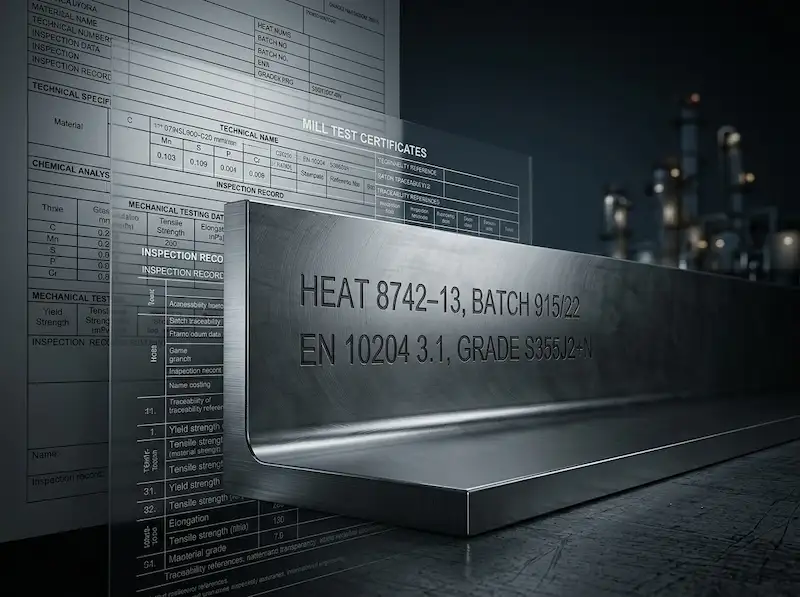
This article provides general technical reference. Certificate and inspection requirements should be verified against the applicable product standard, contract and project specification.
For industrial steel procurement, EN 10204 1 defines different types of inspection documents used to demonstrate conformity and provide inspection information for metallic products.
The four commonly referenced document types are 2.1, 2.2, 3.1 and 3.2. The main differences concern whether test results are provided, whether those results are specific to the products supplied, and whether additional independent or purchaser verification is involved.
For buyers, the important point is that the certificate type should be specified together with the applicable product standard, grade, testing requirements and traceability requirements.
Quick Answer
What are EN 10204 certificate types?
| Type | Document | Test results | Specific to supplied products? | Additional independent verification? |
|---|---|---|---|---|
| 2.1 | Declaration of compliance with the order | No specific test results | No | No |
| 2.2 | Test report | Non-specific test results | No | No |
| 3.1 | Inspection certificate | Specific test results | Yes | No |
| 3.2 | Inspection certificate | Specific test results | Yes | Yes, through additional validation by the purchaser’s representative or independent inspection party |
In practical terms:
- 2.1 confirms compliance with the order without reporting specific test results.
- 2.2 provides test results from non-specific inspection.
- 3.1 provides specific inspection results related to the products supplied.
- 3.2 provides specific inspection results with additional validation involving the purchaser’s representative or an independent inspection party.
The correct certificate depends on the contract, applicable product standard, project specification, regulatory requirements and purchaser requirements.
What Is EN 10204?
EN 10204 is a European standard for types of inspection documents supplied with metallic products.
It defines the different categories of documents that manufacturers or suppliers may provide to demonstrate conformity with an order and to report inspection information.
The standard is particularly relevant to procurement of:
- Carbon steel products
- Stainless steel products
- Structural steel
- Steel plates
- Steel pipes and tubes
- Steel bars
- Steel coils
- Other metallic products
EN 10204 does not by itself define the complete testing requirements for a particular steel product.
The applicable product standard, purchase order and project specification normally determine which chemical, mechanical or other tests are required.
The Four EN 10204 Certificate Types
EN 10204 Type 2.1 — Declaration of Compliance
Type 2.1 is a declaration of compliance with the order.
The manufacturer confirms that the products supplied comply with the requirements of the order, but the document does not provide specific test results.
Typical information may include:
- Manufacturer identification
- Product identification
- Order reference
- Applicable product requirements
- Statement of conformity
When is 2.1 used?
Type 2.1 may be appropriate where the purchaser requires a declaration of conformity but does not require reported test results.
For higher-risk industrial applications, purchasers may instead specify a document containing test results.
EN 10204 Type 2.2 — Test Report
Type 2.2 is a test report based on non-specific inspection.
Unlike Type 2.1, a Type 2.2 document includes test results. However, the reported results are not necessarily specific to the products supplied in the order.
Depending on the applicable product requirements, the report may contain information such as:
- Chemical composition
- Mechanical properties
- Product grade
- Test results
- Applicable standards
2.2 vs 2.1
The simplest distinction is:
2.1 = declaration of compliance without reported test results.
2.2 = test report containing results from non-specific inspection.
EN 10204 Type 3.1 — Inspection Certificate
Type 3.1 is one of the most widely specified inspection documents for industrial steel procurement where product-specific inspection results are required.
A Type 3.1 inspection certificate provides results from specific inspection, meaning the inspection relates to the products covered by the order or the relevant inspection unit.
The document is issued and validated by the manufacturer’s authorized inspection representative who is independent of the manufacturing department.
What Does an EN 10204 3.1 Certificate Typically Contain?
Depending on the applicable product standard and order requirements, a 3.1 certificate may contain:
- Manufacturer identification
- Purchaser and order information
- Product description
- Steel grade
- Dimensions
- Quantity
- Heat number
- Inspection unit or batch identification
- Chemical composition
- Mechanical properties
- Required test results
- Applicable product standard
- Traceability information
- Authorized inspection representative’s validation
The exact contents depend on the applicable product standard and purchase requirements.
For example, a steel product may require reporting of:
- Yield strength
- Tensile strength
- Elongation
- Hardness
- Chemical composition
- Impact test results
- Ultrasonic testing results
Not every 3.1 certificate contains every type of test listed above. The required tests must be defined by the applicable specification or purchase order.
Does EN 10204 3.1 Require Third-Party Inspection?
No.
An EN 10204 Type 3.1 certificate is issued by the manufacturer through its authorized inspection representative.
It does not inherently require a third-party inspection company.
This is one of the most important differences between Type 3.1 and Type 3.2.
If the purchaser requires independent inspection or additional validation, the order may need to specify EN 10204 Type 3.2 or separately define the applicable third-party inspection requirements.
EN 10204 Type 3.2 — Inspection Certificate with Additional Validation
Type 3.2 includes the specific inspection information associated with Type 3.1, together with additional validation involving the purchaser’s representative or an independent inspection party, according to the applicable requirements.
The additional party may be:
- The purchaser’s authorized representative
- An independent inspection body
- Another party designated by the applicable contractual or project requirements
The purpose is to provide an additional level of verification beyond the manufacturer’s own inspection process.
Is 3.2 Always Required for Critical Applications?
No.
Type 3.2 should not be treated as automatically mandatory for an entire industry.
Whether 3.2 is required depends on:
- Applicable legislation or regulation
- Product standard
- Project specification
- Contractual requirements
- Classification society requirements
- Purchaser requirements
- Inspection plan
- Application-specific quality requirements
For example, certain pressure equipment, oil and gas, power generation, nuclear-related, marine or other critical projects may specify independent inspection or Type 3.2 documentation.
The applicable project requirements should always be checked rather than assuming that an industry automatically requires 3.2.
EN 10204 3.1 vs 3.2
The practical distinction can be summarized as follows:
| Requirement | Type 3.1 | Type 3.2 |
|---|---|---|
| Specific inspection | Yes | Yes |
| Product-specific test results | Yes | Yes |
| Manufacturer’s authorized inspection representative | Yes | Yes |
| Additional purchaser/independent validation | No | Yes |
| Third-party inspection inherently required | No | Depending on the specified arrangement |
| Typical use | Industrial procurement requiring product-specific inspection | Projects requiring additional independent or purchaser verification |
Which Should You Specify?
Use 3.1 when the purchaser requires product-specific inspection results but does not require additional independent verification.
Specify 3.2 when the contract, project specification, regulation, classification society or purchaser requires additional validation by an independent or purchaser-appointed inspection party.
How to Choose the Right EN 10204 Certificate
A practical procurement decision can follow this sequence:
Step 1 — Check the applicable product standard
Determine the standard governing the product, for example:
- EN 10025
- EN 10210
- EN 10219
- EN 10088
- ASTM specifications
- API specifications
- Other applicable national or international standards
Step 2 — Check the project or contractual requirements
Review:
- Technical specification
- Inspection and Test Plan (ITP)
- Quality requirements
- Regulatory requirements
- Classification requirements
- Customer specification
Step 3 — Determine the required inspection level
Ask:
Do we need only a declaration of conformity?
If yes, 2.1 may be sufficient.
Do we need test results, but not specifically for the supplied material?
Consider 2.2.
Do we need test results specifically related to the supplied material?
3.1 is generally the relevant certificate type.
Do we also require purchaser or independent verification?
3.2 may be required.
Step 4 — Specify the required tests separately
Certificate type alone does not define every test that must appear on the document.
The purchase specification should identify the required:
- Chemical analysis
- Mechanical testing
- Impact testing
- Hardness testing
- Non-destructive testing
- Dimensional inspection
- Surface inspection
- Other application-specific tests
How to Specify EN 10204 in a Purchase Order
A certificate requirement should be written clearly rather than simply stating:
“MTC required.”
A more useful specification identifies the certificate type and the required inspection information.
Basic Example
Inspection document: EN 10204 Type 3.1 required.
Recommended Example
EN 10204 Type 3.1 inspection certificate required, including chemical composition, mechanical properties, heat number and traceability to the supplied material.
Example for Additional Independent Verification
EN 10204 Type 3.2 inspection certificate required, with additional inspection/validation by the purchaser’s appointed representative or independent inspection body as specified in the contract.
Important Procurement Note
The certificate type should be specified together with the product standard, material grade, dimensions, quantity, testing requirements and traceability requirements.
For example:
ASTM A516 Grade 70, 20 mm × 2000 mm × 6000 mm, EN 10204 Type 3.1 certificate required, including heat number, chemical composition, tensile properties, yield strength, elongation and impact testing as specified.
This gives the supplier significantly clearer instructions than simply requesting an “MTC.”
What Is a Heat Number and Why Does It Matter?
A heat number is a key traceability reference used in steel production and inspection documentation.
It allows the purchaser to connect the supplied material with the corresponding production and inspection records.
A typical traceability chain may look like:
Steel production → Heat number → Material/product → Inspection results → Certificate → Delivery
For industrial procurement, the heat number on the material and the inspection certificate should be consistent with the applicable traceability requirements.
Traceability becomes particularly important when the purchaser needs to verify that the reported chemical and mechanical properties relate to the material actually supplied.
Common EN 10204 Specification Errors
1. Writing only “MTC required”
“MTC” or “Mill Test Certificate” is widely used in commercial communication, but it does not by itself specify the required EN 10204 document type or testing scope.
Better:
EN 10204 Type 3.1 inspection certificate required.
2. Requesting 3.2 without defining the inspection arrangement
Simply writing “3.2 required” may not provide enough information for the supplier to arrange inspection correctly.
The purchaser should identify the required:
- Inspection party
- Inspection scope
- Inspection timing
- Applicable inspection plan
- Required tests
- Documentation requirements
3. Assuming 3.1 means third-party inspection
It does not.
3.1 is a manufacturer-issued inspection certificate.
If independent inspection is required, it should be separately specified or incorporated into the Type 3.2 requirements.
4. Assuming 3.2 is automatically required for a particular industry
Industry alone does not necessarily determine the certificate type.
The purchaser should check the actual:
- Regulation
- Product standard
- Project specification
- Contract
- Classification requirement
5. Failing to specify traceability
For products requiring material traceability, the purchase specification should clearly define how the supplied products must be linked to the relevant inspection documents.
6. Specifying certificate type without specifying tests
“EN 10204 3.1” does not mean that every possible test will appear on the certificate.
The required tests and acceptance criteria should come from the applicable product standard and purchase specification.
EN 10204 vs ISO 10474
EN 10204 is the European reference for types of inspection documents for metallic products.
ISO 10474 2 provides an international reference for inspection documents for steel and steel products and uses corresponding inspection-document concepts.
For international procurement, buyers may therefore encounter both:
- EN 10204
- ISO 10474
The applicable standard should be determined from the purchase contract, product specification and project requirements.
For European steel procurement, EN 10204 is commonly referenced directly.
For international projects, the purchaser may specify EN 10204, ISO 10474, or another documentation requirement depending on the contractual framework.
For Non-European Procurement
EN 10204 is a European standard, but EN 10204-type documentation is widely encountered in international steel procurement.
Buyers outside Europe may encounter similar requirements under:
- ISO standards
- ASTM specifications
- API specifications
- ASME-related project requirements
- Classification society rules
- Customer-specific inspection specifications
However, these standards should not be treated as automatically interchangeable.
A certificate requirement must be evaluated against the specific product standard and project requirements.
For example, an ASTM product specification may define the required material tests and certification requirements independently of EN 10204.
EN 10204 and ASTM Steel Procurement
EN 10204 describes the type of inspection document.
ASTM product specifications generally define the technical requirements for the product.
These are therefore not competing concepts.
A purchase order may legitimately contain both:
ASTM A516 Grade 70 3 + EN 10204 Type 3.1
The ASTM specification defines the applicable material requirements, while the EN 10204 requirement defines the requested inspection document.
This distinction is useful when purchasing steel internationally.
Frequently Asked Questions
Is EN 10204 3.1 the same as a Mill Test Certificate?
Not necessarily.
“Mill Test Certificate” or “MTC” is a commonly used commercial term. An EN 10204 Type 3.1 certificate is a specific type of inspection document with defined requirements.
When accuracy matters, the purchase order should specify EN 10204 Type 3.1 rather than relying only on the term “MTC.”
Does EN 10204 3.1 require third-party inspection?
No.
Type 3.1 is issued through the manufacturer’s authorized inspection representative. Third-party inspection is not an inherent requirement of Type 3.1.
What is the main difference between EN 10204 3.1 and 3.2?
Both provide specific inspection information for the supplied products.
The key difference is that 3.2 includes additional validation involving the purchaser’s representative or an independent inspection party, according to the applicable requirements.
Does EN 10204 require ISO 17025 accreditation for a 3.1 certificate?
The EN 10204 Type 3.1 requirement concerns the manufacturer’s inspection documentation and authorized inspection representative. It should not be interpreted as a blanket requirement that the manufacturer’s laboratory must hold ISO/IEC 17025 4 accreditation.
Specific laboratory accreditation requirements may arise from other standards, regulations, contracts or project specifications.
Is EN 10204 3.2 mandatory for pressure equipment?
Not automatically.
Pressure equipment may be subject to regulatory, product-standard, project and purchaser requirements that determine whether independent inspection or Type 3.2 documentation is required.
The applicable regulation and project specification should be checked for the specific equipment and material.
Which EN 10204 certificate should I specify for steel?
There is no universal answer.
If product-specific inspection results are required without additional independent verification, EN 10204 Type 3.1 is commonly appropriate.
If additional purchaser or independent verification is required by the contract, project or applicable requirements, Type 3.2 may be appropriate.
Procurement Note
When purchasing steel products internationally, specifying the certificate type is only one part of the quality requirement.
A complete procurement specification should normally identify:
- Product standard
- Material grade
- Dimensions and tolerances
- Quantity
- Surface or delivery condition
- Required tests
- Acceptance criteria
- Inspection document type
- Traceability requirements
- Third-party inspection requirements, where applicable
At Wayland Steel, we recommend defining these requirements before quotation and production whenever the material is intended for a controlled industrial application.
Clear documentation requirements help suppliers understand the purchaser’s expectations and reduce avoidable differences in certification and inspection scope.
Key Takeaways
- EN 10204 defines types of inspection documents for metallic products.
- 2.1 provides a declaration of compliance without specific test results.
- 2.2 provides test results from non-specific inspection.
- 3.1 provides specific inspection results for the supplied products.
- 3.2 adds purchaser or independent validation to the specific inspection process.
- 3.1 does not inherently require third-party inspection.
- 3.2 should not be assumed to be mandatory for an entire industry.
- Certificate type does not replace the product standard or testing specification.
- For industrial procurement, specify the certificate together with the required tests and traceability requirements.
- Always check the applicable product standard, contract, project specification and regulatory requirements.
Related Technical References
ISO 404:2013 Steel and steel products — General technical delivery requirements
Article Information
Article ID: WS-INS-2026-007 Category: Technical Topic: EN 10204 Inspection Documents Last reviewed: September 2026 Intended audience: Industrial buyers, procurement teams, QA/QC professionals, engineers and project procurement teams
This article provides general technical information for industrial procurement. Certificate and inspection requirements may vary according to the applicable product standard, contract, regulation and project specification. Always verify the requirements applicable to the specific product and project.
References
-
European Committee for Standardization (CEN), EN 10204:2004 — Metallic products — Types of inspection documents. EN 10204 ↩
-
International Organization for Standardization, ISO 10474:2013 — Steel and steel products — Inspection documents. ISO 10474 ↩
-
ASTM International, ASTM A516/A516M — Pressure Vessel Plates, Carbon Steel, for Moderate- and Lower-Temperature Service. ASTM A516 ↩
-
International Organization for Standardization, ISO/IEC 17025:2017 — General requirements for the competence of testing and calibration laboratories. ISO/IEC 17025 ↩
引用形式 Wayland Steel Editorial Team (2026). EN 10204 Certificate Types Explained: 2.1, 2.2, 3.1 & 3.2. Wayland Steel Insights. https://www.waylandsteel.com.cn/ja-jp/insights/en-10204-mill-certificates-explained/
工業用金属ソリューションが必要ですか?
Wayland Steel は、世界的な工業用途向けに鉄鋼製品、銅合金、アルミニウムソリューションを提供しています。