CuAg0.1 Copper Tube (C10700 / CW019A): Properties, Temper & Applications
A technical guide to CuAg0.1 copper tube, covering C10700 and CW019A designations, chemical composition, electrical and thermal properties, hardness, temper, thermal softening resistance and industrial applications.
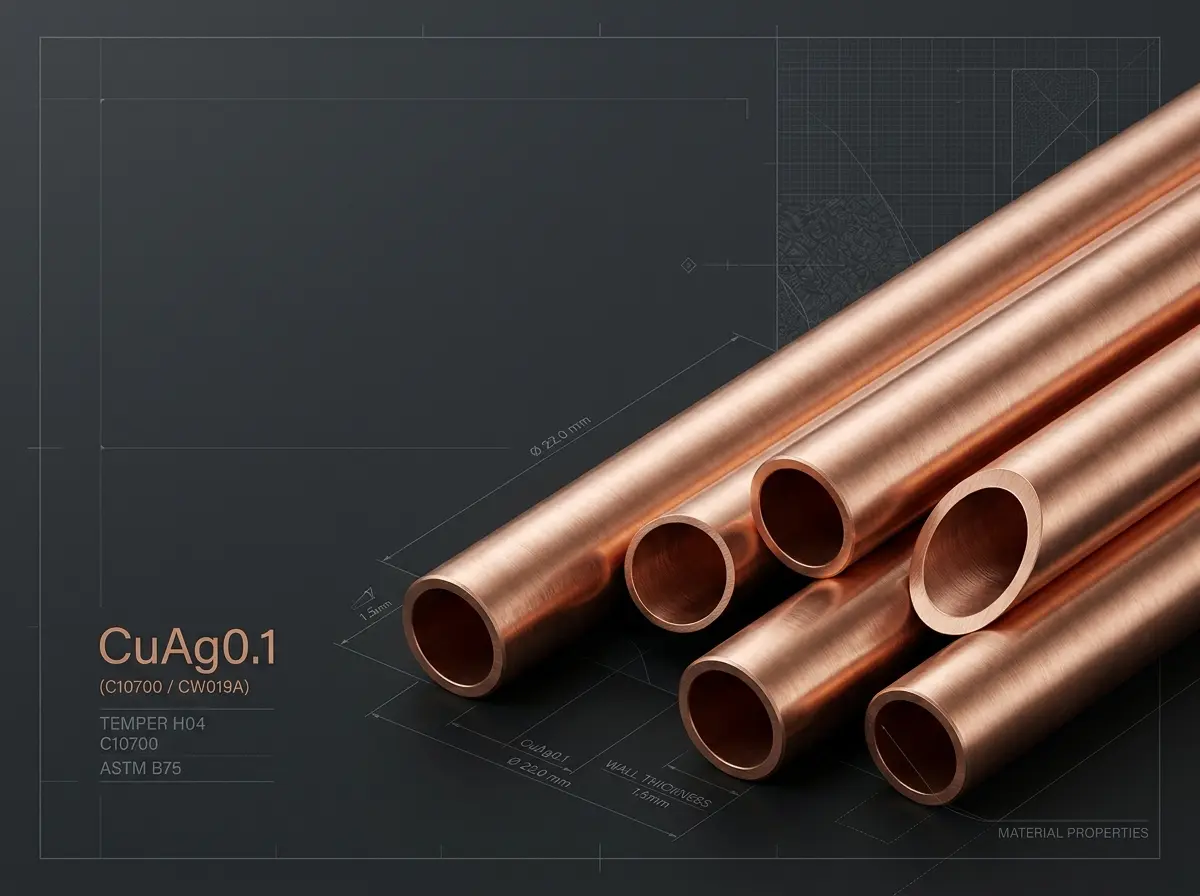
This article provides general technical information about CuAg0.1 (C10700 / CW019A) copper tube properties, temper designations and industrial applications. Final material selection should be verified against the applicable product standard, project specification and service environment.
CuAg0.1 is a silver-bearing oxygen-free copper alloy developed to retain the high electrical conductivity of copper while providing improved resistance to thermal softening. It is commonly associated with CuAg0.10(OF), CW019A and C10700 in different designation systems.
For copper tube, the alloy designation alone does not define the final mechanical condition. Temper, cold work, heat treatment, dimensions and manufacturing route can significantly affect hardness, tensile strength and ductility.
The material is therefore relevant where high electrical conductivity needs to be combined with controlled mechanical properties and improved thermal stability.
What Is CuAg0.1 Copper?
CuAg0.1 is a silver-bearing oxygen-free copper containing a small addition of silver.
The alloy remains fundamentally a high-conductivity copper. The silver addition is primarily intended to improve resistance to thermal softening while maintaining very high electrical conductivity.
Copper Development Association data for C10700 gives the following reference values:
| Property | C10700 Reference Value |
|---|---|
| Copper content | 99.95% min., with Cu value including Ag |
| Silver (Ag) | 0.085% min. |
| Oxygen (O) | 0.001% max. |
| Electrical conductivity | 100% IACS, annealed |
| Density / specific gravity | 8.94 |
| Thermal conductivity | 224 Btu·ft/(ft²·h·°F) |
| Melting point | Approx. 1083°C |
These chemical and physical values are reference data for C10700 and should not be interpreted as the contractual specification for every tube product. Actual requirements should be based on the applicable product standard and agreed inspection criteria. 1
CuAg0.1, C10700 and CW019A
Copper alloys may be identified using different designation systems depending on the applicable standard.
| Designation | Designation System | Material Description |
|---|---|---|
| CuAg0.10(OF) | EN chemical designation | Silver-bearing oxygen-free copper |
| CW019A | EN material designation | Wrought copper designation associated with CuAg0.10(OF) |
| C10700 | UNS designation | Oxygen-free silver-bearing copper |
These designations identify the same general material family, but a complete product specification still needs to define the product form, temper, dimensions and applicable standard.
For example, C10700 tube supplied in an annealed condition can have substantially different mechanical properties from the same alloy supplied in a hard-drawn condition.
The Role of Silver
The small silver addition gives CuAg0.1 a different performance balance from conventional high-conductivity copper.
Its principal value is improved resistance to thermal softening while retaining high electrical conductivity. This is relevant because cold working can increase the initial strength and hardness of copper, while subsequent heating can reduce those properties through recovery and recrystallization.
CuAg0.1 should therefore not be described simply as “harder copper.”
A more accurate description is:
CuAg0.1 combines very high electrical conductivity with improved resistance to thermal softening.
Copper Development Association data identifies electrical conductivity, thermal conductivity and resistance to softening as relevant characteristics of C10700 and lists applications including commutator segments. 1
Key Material Properties
Electrical Conductivity
Electrical conductivity is one of the defining properties of CuAg0.1.
C10700 has a minimum conductivity of 100% IACS in the annealed condition according to Copper Development Association data. 1
The International Annealed Copper Standard expresses conductivity relative to standard annealed copper at 20°C. NIST documents the 100% IACS reference as approximately 58.0 MS/m. 2
High conductivity is important in electrical applications because lower electrical resistance reduces resistive losses and associated heat generation.
Where conductivity is a critical design requirement, the required value should be stated separately in the product specification.
Thermal Conductivity
CuAg0.1 also retains the high thermal conductivity characteristic of copper.
Copper Development Association data gives a thermal conductivity of approximately 224 Btu·ft/(ft²·h·°F) for C10700 at 68°F, equivalent to approximately 388 W/(m·K). 1
Thermal conductivity is relevant in electrically loaded components because efficient heat transfer can help limit local temperature rise. In applications involving significant current density or thermal cycling, electrical and thermal conductivity should therefore be considered together.
Mechanical Properties
Mechanical properties depend strongly on the material’s temper and manufacturing condition rather than chemistry alone.
Cold working increases strength and hardness while generally reducing ductility. Annealing reduces work hardening and generally increases ductility.
For C10700 tube, Copper Development Association data provides typical values for different tempers:
| Tube Condition | Temper | Tensile Strength | Yield Strength* | Elongation | Hardness, HRB |
|---|---|---|---|---|---|
| Light Drawn / Light Cold Rolled | H55 | 40 ksi (276 MPa) typ. | 32 ksi (221 MPa) typ. | 25% typ. | 35 typ. |
| Hard Drawn | H80 | 55 ksi (379 MPa) typ. | 50 ksi (345 MPa) typ. | 8% typ. | 60 typ. |
* Copper.org reports yield strength using a 0.5% extension criterion for these data.
These are room-temperature reference values rather than universal limits for every C10700 tube. Actual requirements depend on the applicable specification, dimensions and product condition. 1
The comparison illustrates a fundamental point:
The same C10700 chemistry can exhibit substantially different mechanical behavior depending on temper.
Hardness & Temper
Hardness should be considered together with temper because there is no single hardness value applicable to all CuAg0.1 copper tube.
For example, the C10700 tube data above gives approximately 35 HRB for H55 and 60 HRB for H80 as typical values, with corresponding changes in tensile strength, yield strength and elongation. 1
The relationship can be summarized as:
Increasing cold work → higher strength and hardness → lower ductility
while:
Annealing → reduced work hardening → lower strength and hardness → higher ductility
Cold drawing therefore affects both the dimensions and mechanical condition of the tube. The final properties result from the combination of alloy chemistry, reduction schedule and heat-treatment history.
Hardness and Strength
Hardness measures resistance to localized deformation, while tensile strength measures the maximum stress sustained during tensile loading.
The two properties generally increase together as cold work increases, but they are not interchangeable. A hardness requirement such as a minimum HV or HRB should not automatically be treated as a complete definition of tensile behavior.
For demanding applications, hardness may need to be specified together with:
- tensile strength;
- yield or proof strength;
- elongation;
- temper;
- conductivity.
Hardness and Thermal Softening Resistance
Hardness describes the condition of the material at the time of testing.
Thermal softening resistance describes how effectively that mechanical condition is retained during subsequent exposure to elevated temperature.
These are related but different properties. Cold working can increase the initial hardness of copper, while thermal exposure can reduce work-hardening effects through recovery and recrystallization.
The silver addition in CuAg0.1 improves resistance to this type of thermal softening.
Hardness defines the delivered mechanical condition; thermal softening resistance describes how that condition behaves under heat.
This distinction matters when a component needs to retain mechanical or dimensional stability during thermal exposure.
CuAg0.1 Copper Tube
CuAg0.1 can be supplied as tube when the application requires the properties of silver-bearing oxygen-free copper in a tubular product form.
Copper.org lists tube among the wrought product forms for C10700 and identifies drawing as one of the common fabrication processes. 1
Tube Dimensions
Copper tube may be defined by:
| Dimensional Parameter | Typical Specification Method |
|---|---|
| Outside diameter | OD |
| Inside diameter | ID |
| Wall thickness | Nominal wall or calculated from OD / ID |
| Length | Fixed or specified length range |
| Tolerance | OD / ID / wall / length tolerance |
For precision components, dimensions should be accompanied by appropriate tolerances.
Where both OD and wall thickness are controlled, the resulting ID should also be checked because dimensional variation can affect machining and assembly.
Tube Manufacturing and Drawing
A simplified production route can include:
Billet preparation → tube forming → drawing / cold reduction → intermediate heat treatment as required → final drawing or sizing → inspection
The exact sequence depends on:
- starting material;
- tube geometry;
- reduction schedule;
- required temper;
- dimensional tolerance;
- surface requirements.
Drawing has a dual role:
Dimensional control + mechanical-condition control
The final tube condition is therefore determined by both alloy chemistry and manufacturing history.
Surface Condition
Surface condition may be important for precision electrical and industrial applications.
Requirements can address:
- cleanliness;
- oxidation or discoloration;
- scratches;
- dents;
- drawing marks;
- residual lubricant;
- surface roughness where relevant.
The appropriate requirements depend on the subsequent manufacturing operation and service environment.
CuAg0.1 Compared with Oxygen-Free Copper
CuAg0.1 and conventional oxygen-free copper can both provide very high electrical conductivity, but their performance balances differ.
| Characteristic | Oxygen-Free Copper | CuAg0.1 |
|---|---|---|
| Electrical conductivity | Very high | Very high |
| Thermal conductivity | Very high | High |
| Thermal softening resistance | Conventional copper behavior | Improved |
| Hardness | Temper-dependent | Temper-dependent |
| Strength | Strongly affected by cold work | Strongly affected by cold work |
| Alloying addition | Minimal | Small silver addition |
| Main selection consideration | High conductivity | High conductivity with improved thermal stability |
Material selection should consider electrical load, temperature, mechanical condition, manufacturing route and service requirements.
Applications
CuAg0.1 is relevant to industrial and electrical applications where high conductivity is combined with improved resistance to thermal softening.
Typical application areas include:
- electrical conductors;
- busbars;
- specialized conductive components;
- electrical equipment;
- motor components;
- commutator-related components.
Motor and Commutator Components
Motor and commutator components illustrate why several material properties may need to be considered together.
Such components can experience electrical current, heat, mechanical contact and repeated operating cycles. Electrical conductivity is therefore important, while thermal and mechanical stability can also influence material selection.
C10700 is documented for commutator-segment applications, with electrical conductivity, thermal conductivity and resistance to thermal softening among the relevant material characteristics. 1
Depending on the product form, semi-finished CuAg0.1 material may subsequently be cut, machined or formed into individual components.
Other Industrial Applications
Depending on product form and specification, CuAg0.1 may also be considered for:
- high-conductivity electrical components;
- conductive parts exposed to elevated temperature;
- busbars and related components;
- specialized terminals and connectors;
- motor and power-equipment components;
- other applications requiring high conductivity together with controlled mechanical properties.
How to Specify CuAg0.1 Copper Tube
A complete specification should define both the alloy and the final product condition.
Material
Specify the required designation, for example:
- CuAg0.1;
- CuAg0.10(OF);
- C10700;
- CW019A.
Where multiple designation systems are referenced, the applicable material standard should also be identified.
Product Form
Define the required form and condition, such as:
- drawn tube;
- light-drawn tube;
- hard-drawn tube;
- annealed tube.
Dimensions
Specify:
- outside diameter;
- inside diameter;
- wall thickness;
- length;
- dimensional tolerances.
Mechanical Requirements
Where applicable, define:
- temper;
- hardness;
- tensile strength;
- yield or proof strength;
- elongation.
For hardness, specify the actual test scale and acceptance criterion rather than assuming an automatic conversion between HRB and HV.
Electrical Requirements
For electrical applications, conductivity or resistivity may need to be specified independently.
For example:
Minimum electrical conductivity: [required value] % IACS at 20°C
Surface Requirements
Where relevant, define:
- surface cleanliness;
- surface finish;
- acceptable drawing marks;
- oxidation limits;
- scratches or dents.
Inspection and Documentation
Depending on the application and customer requirements, documentation may include:
- chemical composition;
- dimensional inspection;
- hardness test;
- tensile test;
- conductivity test;
- material certificate;
- inspection report;
- traceability information.
Frequently Asked Questions
What is CuAg0.1 copper?
CuAg0.1 is a silver-bearing oxygen-free copper alloy designed to combine very high electrical conductivity with improved resistance to thermal softening.
Is CuAg0.1 the same as C10700?
CuAg0.10(OF), CW019A and C10700 are commonly associated with the same silver-bearing oxygen-free copper material family. The complete product specification should still be confirmed because product form, temper and applicable standards determine the final requirements.
What is CW019A?
CW019A is an EN material designation associated with CuAg0.10(OF), a silver-bearing oxygen-free copper.
What is the typical hardness of C10700 copper tube?
Copper Development Association reference data gives approximately 35 HRB for H55 light-drawn / light-cold-rolled tube and 60 HRB for H80 hard-drawn tube as typical values. These are temper-specific reference values, not a universal hardness range for all C10700 tube products. 1
What is the hardness of CuAg0.1 in HV?
CuAg0.1 does not have one universal HV hardness value. Hardness depends on temper, cold work, heat treatment and product condition. If a purchase specification requires Vickers hardness, the required HV value and test method should be explicitly specified and verified on the supplied product.
Is CuAg0.1 suitable for motor commutator components?
C10700 is documented for commutator-segment applications where high electrical conductivity, thermal conductivity and resistance to thermal softening are relevant. 1
Can CuAg0.1 be supplied as copper tube?
Yes. C10700 is available in tube form, with dimensions, temper, tolerances and surface requirements depending on the applicable specification and manufacturing capability. 1
Conclusion
CuAg0.1 is a silver-bearing oxygen-free copper alloy whose key characteristic is the combination of very high electrical conductivity and improved resistance to thermal softening.
For copper tube, the final properties depend not only on alloy designation but also on temper, cold work, heat treatment, dimensions and manufacturing route. Hardness is therefore an important mechanical parameter, but it should be considered separately from tensile strength and thermal softening resistance.
A complete CuAg0.1 tube specification should connect the alloy, product form, dimensions, temper, mechanical properties, electrical requirements and inspection criteria to the intended service conditions.
References
-
Copper Development Association Inc., Copper.org Alloy Database, C10700 — Oxygen-Free with Ag. Copper.org — C10700 Alloy Database ↩ ↩2 ↩3 ↩4 ↩5 ↩6 ↩7 ↩8 ↩9 ↩10 ↩11
-
National Institute of Standards and Technology (NIST), Mechanical Properties of Metals and Alloys, including the International Annealed Copper Standard (IACS). NIST — Mechanical Properties of Metals and Alloys ↩
引用为 Wayland Steel Editorial Team (2026). CuAg0.1 Copper Tube (C10700 / CW019A): Properties, Temper & Applications. Wayland Steel Insights. https://www.waylandsteel.com.cn/zh-cn/insights/cuag01-copper-tube-properties-temper-applications/