01
ASTM A276 / A276M
Stainless steel bars and shapes
Standard specification for stainless steel bars and shapes.
Stainless Steel — Industrial Product
Austenitic 304 stainless steel bar supplied to ASTM A276 / EN 10059 for machinery, food processing, chemical and general industrial applications.
Overview
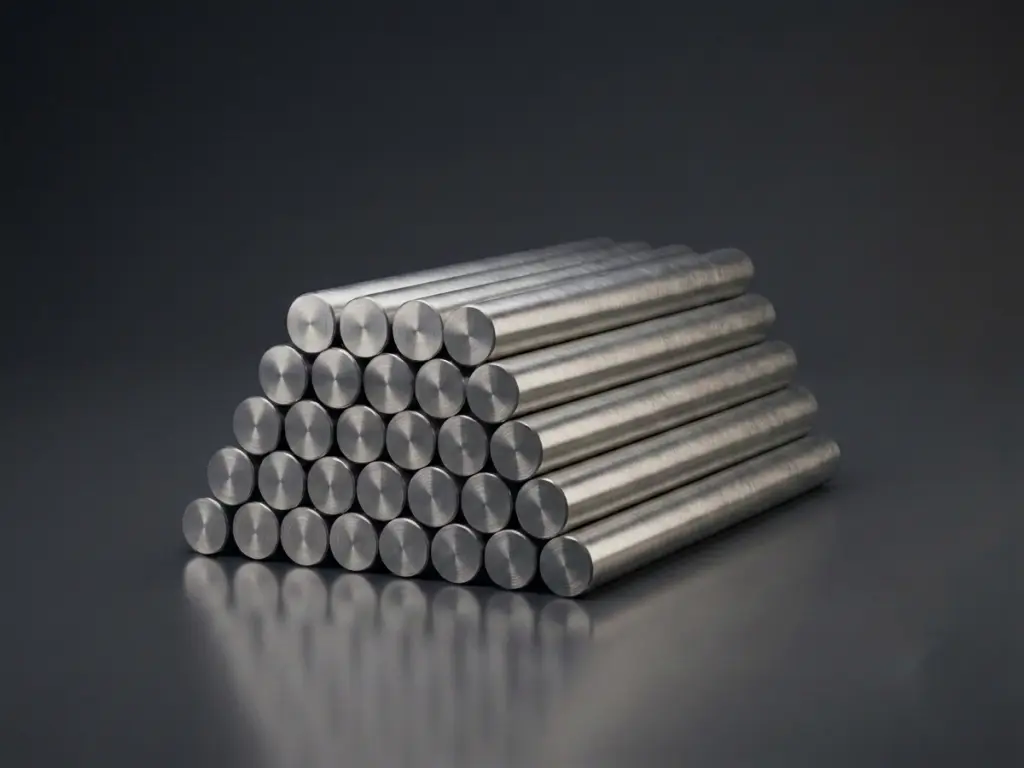
Stainless Steel Bar 304 combines austenitic stainless steel with 18–20% chromium and 8–10% nickel for reliable general corrosion resistance and consistent dimensional control. The balanced chemistry delivers excellent formability, weldability and machinability, making the bar suited to machinery shafts, fasteners, food processing equipment, kitchen fabrication, chemical hardware and general industrial components. Supplied to ASTM A276 with mill test certification per EN 10204 3.1, it supports global procurement as a standard grade for industrial component manufacturing.
Key Characteristics
Typical Applications
Specifications
Numbers in this section correspond to the applicable product standard, formatted for direct use in enquiry and approval documents.
Final supply is confirmed against the project drawing, purchase agreement and the mill test certificate.
Reference: ASTM A276 304.
Reference: ASTM A276 304 at room temperature.
Reference: Typical material values, 304.
Reference framework
The applicable product, dimensional and inspection standards should be confirmed together in the purchase specification.
Standard specification for stainless steel bars and shapes.
European reference for stainless steel wire rod and drawn wire (also covers drawn bar).
European reference for hot-rolled flat steel bars for general purposes.
Japanese reference for stainless steel bars for general, machine and structural use.
Chinese reference for stainless steel bars.
Defines inspection document types such as 3.1 and 3.2 for metallic product delivery.
Capability
From custom dimensions and precision sizing to heat treatment, surface finishing and product-specific processing, Wayland coordinates supply solutions tailored to your requirements.
Cut-to-length and custom cutting according to order requirements.
Non-standard dimensions, tolerances and dimensional combinations subject to product and mill capability.
Precision sizing and dimensional control for tighter tolerance requirements.
Cold drawing, cold sizing and other cold-working processes where required.
Heat treatment according to material, specification and applicable standard.
Surface treatment and finishing according to product, specification and application requirements.
Turning, drilling, milling and other machining operations where required.
Bending, forming and other shape modification according to drawings or order requirements.
Customization
Custom dimensions, lengths, surface conditions, end preparations and inspection requirements can be supplied according to project specifications. Final capability is confirmed per enquiry based on grade, size range and applicable standard.
Quality
Inspection and documentation procedures are coordinated to meet the requirements of the applicable product standard and the project specification.
Documents
Documents
Documents
Documents
Selection
A well-prepared specification is the most efficient defence against clarification cycles.
Choose the material grade according to service conditions, performance requirements and applicable standards.
Specify the required dimensions, surface condition, heat-treatment condition and delivery requirements.
State the applicable product standard, dimensional standard and governing project specification.
Confirm inspection, testing, certification and documentation requirements before order placement.
Example procurement specification
A complete specification suitable for enquiry, covering product, technical requirements, certification and delivery terms.
Logistics
From mill dispatch to destination port, each stage is coordinated with the nominated forwarder and documented against the purchase specification.
Export-suitable packaging with surface and edge protection.
Bundled, wrapped or crated according to product form and transport mode. Outer surface protected with weather-resistant material; ends and edges shielded against transit damage.
FCL container for standard sizes; break bulk for oversized cargo.
Container loading via nominated forwarder. LCL and dimensions outside container allowance coordinated against the mill dispatch schedule.
Commercial invoice, packing list and certificate of origin.
Mill documentation travels with the shipment. EN 10204 3.1 / 3.2 certificates and third-party inspection reports provided as per purchase specification.
Sea freight as standard; alternative routes on request.
FCL / LCL container shipment or break bulk for oversized dimensions. Logistics coordinated through the nominated forwarder.
FOB · CFR · CIF · FCA · EXW arrangements available.
Incoterm 2020. Port of loading: Shanghai / Ningbo / Shenzhen. Final destination and terms confirmed per enquiry.
FAQ
Most enquiries reduce to a small set of recurring technical questions.
304 stainless bar (1.4301 / SUS304) is the standard 18-8 austenitic grade, offering good general corrosion resistance and formability for industrial, architectural and food-grade applications.
304 is austenitic and essentially non-magnetic in the annealed condition. Cold working may induce slight magnetism.
Round, square, flat, hexagonal and angle. Round is the most common.
Yes. 304 offers excellent weldability. 304L is preferred for heavy welded assemblies to avoid sensitization.
Standard mill tolerance for hot-rolled bar; tighter h9 / h10 for cold-drawn bar. Custom tolerance on request.